
The below resource provides a great basic understanding of the relationship dynamics at play between M/Earth and our Sun. A key point to keep in mind–all data correlations cross system are measured in watts/square metre. As we reinstitute the Light Foundations that regulate all biological expression, this watts/square metre data will be invaluable information to aid in recalculation, reassessment, and retuning based on correct solar light fundamentals.
The symbol for square cubit is cu².
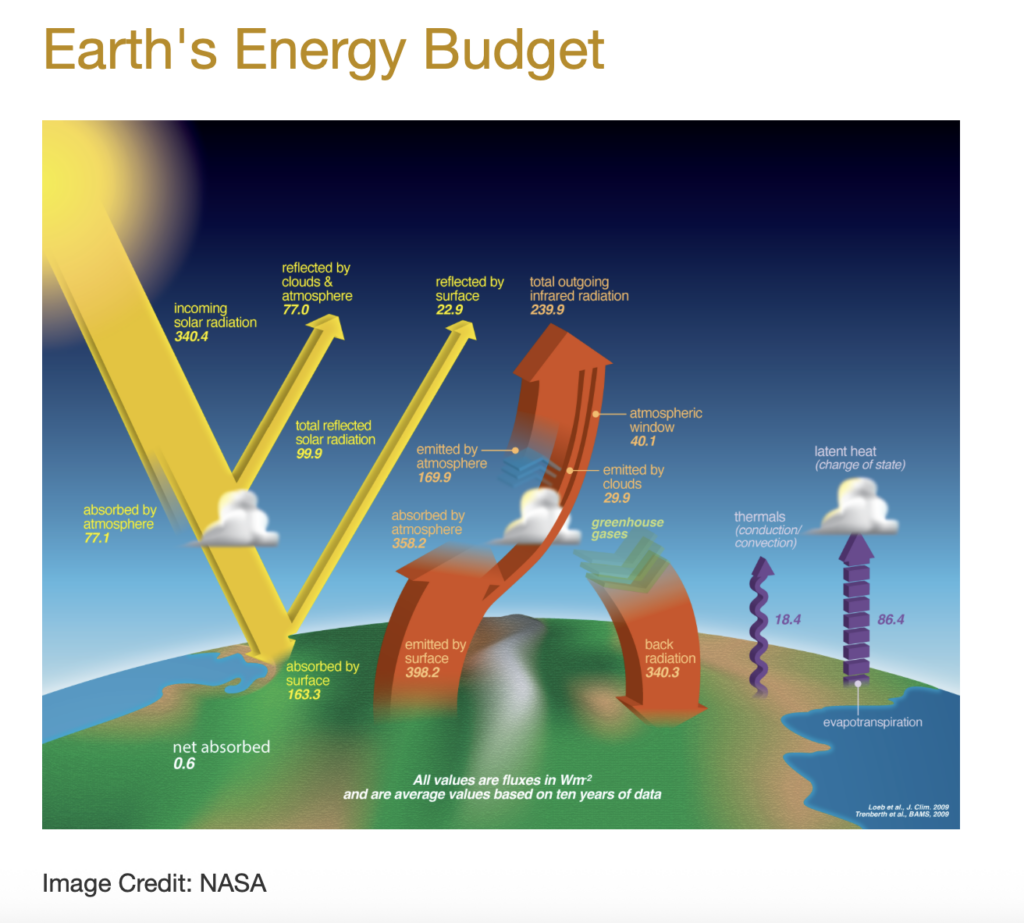
“Based on the physics principle of conservation of energy, this radiation budget represents the accounting of the balance between incoming radiation, which is almost entirely solar radiation, and outgoing radiation, which is partly reflected solar radiation and partly radiation emitted from the Earth system, including the atmosphere. A budget that’s out of balance can cause the temperature of the atmosphere to increase or decrease and eventually affect our climate.The units of energy employed in measuring this incoming and outgoing radiation are watts per square meter (W/m2).
https://mynasadata.larc.nasa.gov/basic-page/earths-energy-budget

The Earth’s system is characterized by the interaction of processes that take place on molecular (very small) and planetary (very large) spatial scales, as well as on short and long time scales. Before scientists may begin their work with these data, it is important that they understand what the data are. As we attempt to understand how these complex systems and phenomena behave and interact, we must think in terms of time span (e.g., seconds, days, centuries, epochs, etc.), size (e.g., electrons, water bodies, planets, etc.), and energy flowing within the systems/phenomena (e.g., photons, batteries, solar energy). To try to make sense of all of these data, scientists view the data from three different contexts: Scale, Quantity, and Proportion.
https://mynasadata.larc.nasa.gov/basic-page/scale-proportion-and-quantity